
Do you want to be informed on new Posts on this Thread? (members only)
| S&S Swan General - Pros and Cons of Teak Deck |
|---|
|
Join Date: 26 February 2008
Posts: 1 |
||
|---|---|---|
|
Pros and Cons of Teak Deck |
|
Join Date: 03 March 2007
Posts: 243 |
||
|---|---|---|
|
|
|
Join Date: 27 February 2007
Posts: 36 |
||
|---|---|---|
|
In my humble opinion, there is nothing more beautiful than a Swan with teak decks. Of course beauty is in the eye of the beholder, and a Swan is still a Swan teak or no teak. I'd be curious as to what a Swan without teak decks would look like along the toe rail. The teak on our Swan 38 is flush with the toe rail and flush with other parts of the deck that make it look like a perfect fit. Without the teak there would be more right angles and corners to stub a toe on. (I guess that's why they call it a toe rail?) Also, I'm guessing that water may not drain as good along the sides of the deck if this was the case. When we bought our Swan 38, the teak was in need of refinishing, and some of the teak needed to be replaced. All of the screws had to be drilled out and filled with epoxy before screwing new holes. I was concerned about water ingress as the teak and caulking looked bad in spots. However, after drilling examination holes all around the deck into the fiberglass, the core was in great shape. Ours has a foam core in most places, and the fiberglass is thick. No signs of water getting in through the screw holes in 30 years. Of course it is pretty dry here in southern California. If getting a new deck, you definitely want to go with the non-screw method, but if refinishing an older deck, if a lot of the wood is in good shape (ours was still pretty thick after 30 years), you may be able to stretch out an existing deck for another 10+ years by refinishing (new screws, holes, epoxy, sanding, etc...). I also think that a Swan with a good teak deck has a better resale value than one without. (personal opinion). Although if I had to chose between two Swans of equal value, one with bad teak decks, and one with new nonskid, I would probably go with the non-skid one. Refinishing or replacing a teak deck is timely and expensive, and takes time away from the joys of sailing these fine vessels. -Nathan S/V Inspiration (Swan 38/090) |
|
Join Date: 02 March 2008
Posts: 1 |
||
|---|---|---|
|
having owned a hinckley 59 that had non-skid, swan 77-01 with teak decks, and a megayacht with teak decks, i suggest the following: teak is unbearably hot under bare feet in the tropics. it stains (red wine, coca cola, suntan lotion, potato chips, etc). it requires ongoing maintenance to keep from going grey -- though many prefer it that way. in the old days, teak decks were thicker; but with the recent shortage of good teak, now teak decks tend to be very thin even when new....so after a few sandings, they're EXTREMELY thin. they do look great (especially the first week you own them), and they offer good non-skid properties, but again, in hot weather you have to wear deck shoes or sandals because your bare feet can't take the heat. if you have crew and you and your crew commit to look after the teak, that's OK, otherwise, GRP (diamond-tread) or sand-in-paint non-skid is far more durable and easy to maintain, if less glamorous |
|
Join Date: 04 June 2007
Posts: 3 |
||
|---|---|---|
|
About teak deck there are as many opinions as boatowners. The question is not rational, so the answer cannot be either. Last winter I remowed the 18yrs old teak deck from my Swan 36 from 1967. Of course after removing all the fittings on deck. I put all the deck material in a box: it weigted 70 kg dry without screws. The deck was spackled, two layers glasfiber added and painted by a professional. Then carefully planned, designed and cut anti slip material by french TBS was glued with very thin layer white sikaflex. The result made my boat look ligther, cleaner and as new. No more detailed brushing(by crew of two), no sandpapering, no hidden sand, and no dropping in the bunks. This was my choice. Wash and sail! 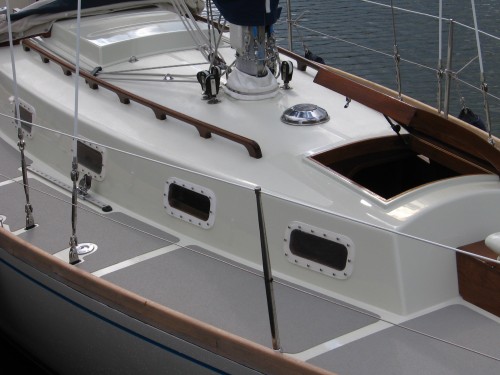 |
|
Join Date: 02 June 2007
Posts: 43 |
||
|---|---|---|
|
When I bought Pleiades (1974 Swan 41/018) in 2005, I knew one of the reasons the owner was selling her was his fear that the screwed-down teak deck needed to be replaced. Since the rest of the boat was sound, I considered very carefully the ramifications of purchasing a boat with a, then 31 year old, deck. The primary symptom exhibited at the time was that, when drying after rain, certain areas would remain wet due to water wicking by capilliary action along some caulked joins and the chain plates leaked. To make a long story short: since there was no evidence of deck core moisture, no evidence of extensive teak delamination from the deck, I bought the boat. Since then, I have not regretted my decision. I found that the deck was still at least 12 mm thick (1/2 inch) and that the wood was in excellent condition beneath the silver weathered surface. As a result, all I did was recaulk key areas, including all the deck pentrations, and I applied one treatment of teak oil but did not sand the deck. It would only have taken a moderate sanding to make it look like furniture for a short time before it weathered again. Hardly worth it. In my opinion, the owner's fear of the deck condition, at least in this case, was unwarranted, and I think that nothing looks better than teak. |
- Threads : 1804
- Posts : 10761
- Members: 862
- Online Members: 0
